


Difficulties and Diagnoses
Under construction. This page will eventually be the home of fundamental information for different types of diagnoses and difficulties people struggle with that often prompt professional services. Please note: much of the information I post here is simply my sense of things, particularly in how the material is organized. While professionals endeavor to share vocabulary, our philosophy/organization of this material is often a little different.
Before We Discuss Items in Detail- The DSM-IV (TR) (Diagnostic and Statistical Manual IV, Text Revision)
*note* More info on the new DSM-V below this section
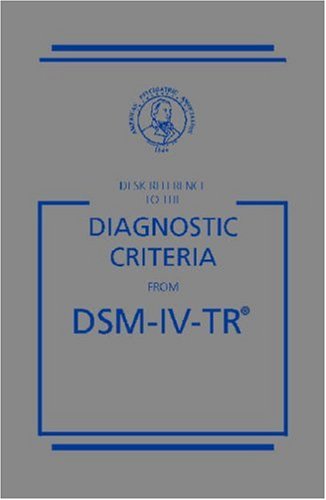
The DSM-IV (soon to be the DSM-V) is the industry standard primary source of diagnostic information for all issues of emotional and mental “illnesses” (for brevity’s sake), developmental disabilities, and more. These problems range from what most of us are aware of- depression, anxiety, PTSD, bipolar disorder, addiction, schizophrenia and etc, illnesses of childhood (ADHD, for instance), illnesses of the elderly (dementia, Alzheimer’s), developmental disabilities (Downs Syndrome, etc), and others. All mental health professionals are charged with the responsibility of using this book as the means of identifying and diagnosing problems that we treat. It is broken up into several sections that cover different kinds of problems.
Just like the common cold or other physical illnesses, one does not have to have every symptom to be diagnosed with a problem. It’s also possible to have more than one diagnosis at a time, and often is. This book is arguably based on a “medical model” of symptoms (usually observable, measurable indicators of problems), diagnosis, etiology (study of where an illness comes from), treatment options, and prognosis.
The “manual” does little to give direction about types of treatment, but enables us to have a “convention” (some agreement) about how we diagnose problems, and communicate about them in a shorthand manner. Am mentioning this book first, because the “names” (diagnoses) we give to different kinds of problems we treat all come from this book. Below, I will describe some of these problems and diagnoses, loosely defined and described by the book for some ease of use and understanding for non-professionals.
As Promised Above: About the DSM-V

Should probably start with a disclaimer: I am not a fan. Will use it because I have to (Europe and others at least, are resisting its use…), but I find even more of this version problematic and egregious than the previous.
As noted above regarding the DSM-IV (TR) and others, the book is a convention- a tool agreed upon (largely) by the American Psychiatric Association. It gets updated periodically, to reflect what the (at least the APA’s) newest thinking is about psychiatric problems. Often, as with this version, some of what is changed are specific diagnoses (the symptoms and other related concerns), or categories of problems (some issues, for instance, Autism and addiction problems have been given “ranges” or “spectrums” in which they now are presented).
I’m not going to go into details and specifics of what is changed – as some of you might have noted in the link in the above paragraph, that was 19 pages long. As with lots of things, some of these changes were arguably good and useful, or not, depending on who you speak to about them. Will say briefly that most changes occurred in areas of addiction, “neurodevelopmental disorders”, “thought disorders” (problems like schizophrenia, and related issues), what I call “emotional illnesses” (depression, anxiety, trauma, bipolar disorders, addictions, and more). Some of these changes were about categorization, some about nomenclature changes, some about how symptoms are described or organized by the problems they are related to. Will reserve my critiques to spare your eyes (they’d be lengthy), but again, specific changes can be found here.
Stuff We All Suffer From: Problems, Issues, Technical Difficulties
Oversimplifying (maybe by a margin), most all our lives have pitfalls between us and us, us and other people, us and the planet in general. Am referring here to relationships (mates, friends, kids, family members, neighbors, coworkers…), school, work, self-awareness, death/loss, physical problems, parenting, money, the environment (natural disasters, property, culture, subculture, etc) and more. Some of these things are more commonly referred to as stress or “stressors”. Most of these things, sadly, not only don’t have “manuals” or blueprints, but we often get little instruction or direction about. As a result, navigating such can be daunting and difficult.
These are all reasons people come to see a therapist, when they effect our relationship with ourselves (something not everyone considers), and other people. While some of these concerns might require the services of other folk (accountants, career counselors, physicians), the “coping skills”, problem-solving (of some of these issues) and feelings about them are the focus of therapists and other mental health professionals.
As for Diagnoses…
“Mood and/or Affective Disorders”, or, Feeling Problems
Will not be covering them all here of course, and, oversimplifying, these are the most commonly diagnosed and treated problems. Depression, anxiety/panic, bipolar disorder (AKA the once and former “manic depression”), and other problems.
Depression: the Most Diagnosed Mental Health Issue
Summary/oversimplified version:
When one feels (emotionally speaking) “sad/blue/down” for a period of time, that may be an indication. It may or may show up for us in the presence of identifiable circumstances, sometimes not. Often, we lose interest in things that we used to do and enjoy. Our self esteem or self worth may be diminished. Sleeping and eating habits may become unhealthy, we may be fatigued. We may pick up other behaviors that are not healthy for us. Occasionally there may be real, or even perceived physical problems that might be related to being depressed. These may show up differently for children, adolescents, adults, and seniors.
Causes for depression, as with most “mental health” issues, can be circumstance or biology, or both. There are differing views on this. My sense is that causes tend to be a constellation of issues, rather than singular. There are different types of depression- “Major Depressive Disorder”, dysthymia (a condition where symptoms persist for more than two years), postpartum depression, and a few others.
As all of us are likely painfully aware, there are a large number of pharmacological interventions available. These are often helpful, but not always necessary means of treatment. Other types of treatment may be talk therapies, behavioral interventions, dialectical or journaling interventions, and many more.
Anxiety Disorders
Summary/oversimplified version:
Sometimes, fears/anxious feelings are accompanied by physical sensations and more. These feelings may be manifested by identifiable causes- social situations, specific “phobias” (fear of going outdoors known as “agoraphobia”, snakes, spiders, etc), or even “generalized” anxieties. Anxiety is often described as a feeling of worry, unrest, apprehension, or racing/repeating thoughts (referred to as “rumination”). These may also show up with the aforementioned physiological sensations- shortness of breath, sweaty palms, narrowing of senses. In more severe cases people may complain also of panic- with dizziness, shaking, complaints or feelings of not being able to breathe, even fear of dying. While these feelings may be prompted by identifiable causes as mentioned above, sometimes, these can seem to come from “out of nowhere”.
Like depression, there are different types of anxiety problems. Generalized anxiety disorder, social anxiety disorder, and more. Some of these symptoms are also associated with other problems like obsessive compulsive disorder (OCD), post traumatic stress disorder (PTSD), and others. Also similar to depression, some cite biological causes, others “environmental”, some both.
There are a number of available treatments for anxiety based disorders. Some of these include medications, behavioral interventions, talk therapies, and more.
Post-Traumatic Stress Disorder
Summary/oversimplified version:
Due to it’s prevalence, intensity, and how often people come in for therapy around it, though an anxiety disorder, should talk about it specifically. Once called “shellshock”, then “battle fatigue”, then “operational exhaustion”, now PTSD (tip of the hat here to the philosopher/comedian George Carlin for his resistance to euphemisms). PTSD is, like all mental/emotional health problems, a constellation of potential symptoms. These are the result of an intense emotional trauma, or sometimes repeated emotional traumas of different intensities over time. PTSD is supposed to be diagnosed in the wake of some experience where there was both a risk of serious injury or death to self or others, AND a response that involved “intense fear, helplessness, or horror”. We have found that these symptoms arise for a multitude of experiences, not just wars– which is why (in part) “mental health professionals” had to come up with another word. Some of these include (but are not limited to): war, sexual or physical abuse, home invasion, kidnapping, accidents (plane/car/train/bus, etc), kidnapping, explosions, natural disasters and more.
The symptoms are often deep, complicated by number, intensity, and sometimes subtlety. Too much for lots of detail here. Some of these though can manifest in the form of “flashbacks” (re-experiencing the event), dreams, numbing out emotionally, avoiding discussion/people/places/things that are reminders of the event/s, inability to remember significant parts of the experience, anger/aggression, “hypervigilance” (being on guard, super-aware of environment, increased “startle response”), some physiological signs of stress. These may be accompanied by anxiety/panic attacks, even “dissociation” (“checking out” mentally/emotionally, so to speak). There’s many more, but in the interest of brevity…
Most people need stabilization of different kinds, just to get through the experience. Short/medium/long term, individuals suffering from this may need to “debrief” the event, and will certainly need therapy. Sometimes the intensity of the symptoms may die down over time, but traditional “talk therapy” and other newer types of interventions certainly assist both in the speed and effectiveness of relief from these symptoms. Different kinds of medications are sometimes prescribed. It’s hard to be specific about this with PTSD, as the symptoms that present can range from anxiety, to depression, even to “psychotic” (not “crazy” or necessarily dangerous, one such type can be the “dissociation” described above)- this being the case, antidepressants, antianxiety agents, and/or antipsychotics may all be useful to assist in the process. Support groups when available, are also very helpful with this issue.
More information about this PTSD and treatment can be found here and here.
Bipolar Disorder
Summary/oversimplified version:
Bipolar disorder used to be referred to as “manic depression” (also the title of a great Jimi Hendrix tune about someone in love with music, but I digress). Unfortunately, the general public often has some misunderstandings about this illness, in part because it’s simply a complicated problem, but also because of poor “differential diagnosis” on the part of clinicians (helping professionals). The term “differential diagnosis”, simply, is the ability to differentiate one diagnosis from another. Bipolar disorder is poorly/misdiagnosed because of an oversimplification. We often see this problem as swinging from one mood to another (hence the idea of “bipolar” or, two poles of mood). Often, this is normal. This might more clearly be described by the old terms- mania, and depression. The differences are actually between happiness and mania, and sadness and depression. One way bipolar disorder might be diagnosed (again, oversimplifying) as swinging between happiness and sadness, without any identifiable reason. Or, between mania and depression- two extreme poles of human experience. These swings are referred to as “mood lability”.
Bipolar disorder is thus broken up into two categories of symptoms (still oversimplifying). These are broken up into “manic” symptoms, and depressive symptoms. How these show up are part of what has prompted mental health professionals to break up bipolar disorder into different types (which I will not be discussing in detail)… these will be mentioned below.
This “bipolarity” is not the only symptom that shows up for folk who suffer from this illness. They will often be difficult to understand because their thoughts and energy are so intense, they are unable to stay focused on one topic of discussion at a time (tangentiality). Or, their communication may suffer from “looseness of association”- their train of thought when moving from one idea to another may only be loosely associated, as opposed to being able to clearly understand how the person got from one idea to the other. Their speech may also be “hyper”, “pressured” or “rambling”, meaning, they may be fast and/or difficult to interrupt or interject with. Of course many of us are probably now saying that MOST of the people we know suffer from these symptoms! That may be true, but there are more symptoms necessary to have the problem, and being able to diagnose this takes quite a bit of education and experience.
Some of the other symptoms are: grandiosity or “expansive” mood/ego. Sometimes, this “mania” prompts someone to go on sexual or spending binges. There may be “risky” or dangerous, even aggressive behaviors. Because of the energy these folk experience, mania is often accompanied by little sleep.
As noted above, when these mood swings occur, those afflicted may go from manic symptoms, to depressive symptoms. As a rule, these mirror the ones noted for depression above (sometimes prompted by remorse for the manic behavior, or even sadness due to the loss of what some bipolar people call the “manic high”). Because this was addressed above, I won’t repeat those symptoms here.
Like depression and anxiety disorders, there’s different types of “bipolar disorder” as I mentioned above. As I said, not going into the details, but some of these are hypomanias, cyclothymias, bipolar I and bipolar II.
The causal forces for this problem are often thought to be genetic/hereditary, sometimes prompted by emotional experience, lack of sleep, or substance use. There are several theories as to how these symptoms are manifested/caused from a physiological standpoint. Almost always, this problem has to be treated first with medication, preferably in conjunction with other treatments and lifestyle changes.